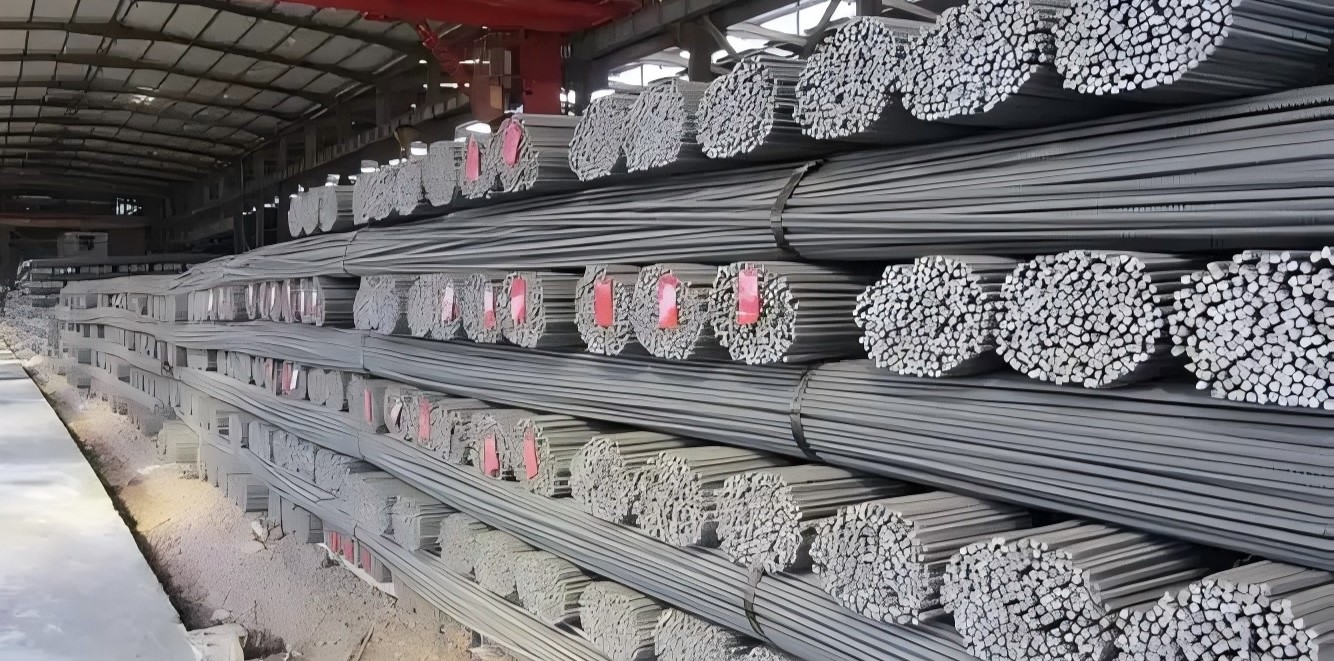
Core Positioning and Industry Value of Rebar
Rebar, formally known as Hot-rolled Ribbed Steel Bar, is an indispensable core material in construction engineering, primarily used as the skeletal support for reinforced concrete structures. Its surface features two longitudinal ribs and evenly distributed transverse ribs (classified into three types: helical, herringbone, and crescent), which enhance the bond strength with concrete, thereby improving the stability and load-bearing capacity of building structures. From residential buildings to large bridges and key projects, the quality of rebar directly determines the safety rating and service life of a structure. It currently occupies half of the Chinese construction steel market and serves as the "backbone" of infrastructure development.
Rebar Model Specifications: Standards, Classification, and Key Parameters
Model Naming Rules
The rebar model is based on the prefix "HRB," which corresponds to the English abbreviations for "Hot-rolled," "Ribbed," and "Bars." The suffix number represents the standard yield strength value (unit: Megapascal, MPa). An "E" suffix denotes seismic-grade rebar (e.g., HRB400E), while an "F" suffix indicates fine-grain rebar (e.g., HRBF400).
Main Strength Grade Classification
- HRB335 (Grade 2): The old designation was 20MnSi, with a yield strength of 335 MPa and a tensile strength of 510 MPa. It was widely used in general civil engineering. However, with the promotion of high-strength steel, it is being gradually phased out and is now only used in some renovation projects.
- HRB400/HRB400E (Grade 3): The current mainstream model in the market, with a yield strength of 400 MPa and a design tensile strength of 360 MPa. The material is mostly alloy steel such as 20MnSiV and 20MnSiNb. Among these, the HRB400E seismic rebar is the preferred choice for high-rise buildings, bridges, and other key projects due to its good toughness and strong fatigue resistance. The "E" in the grade designation represents seismic certification (e.g., Shaanxi Longgang's "4EYLG12," where "4E" stands for HRB400E).
- HRB500 (Grade 4): With a yield strength of 500 MPa, it is 25% stronger than Grade 3 steel. It can reduce steel consumption by approximately 15%-20%, offering advantages in energy conservation, carbon reduction, and cost control. It is commonly used in large-span structures and heavy-load projects.
- HRB600 (Grade 5): The latest generation of high-strength rebar, with a yield strength of 600 MPa. It is currently the highest-strength grade of construction rebar in China. Its corrosion resistance and durability are significantly improved, greatly extending the lifespan of buildings and representing the direction of industry technological upgrading.
- CRW·Q235: A carbon structural steel with a yield strength of 235 MPa, used as the parent material for cold-rolled ribbed steel. It complies with the new national standard implemented in September 2024 and is mainly used for auxiliary components with moderate strength requirements.
Specification and Dimension Standards
The nominal diameter of rebar ranges from 6 mm to 50 mm. Common specifications include 6, 8, 10, 12, 14, 16, 18, 20, 22, 25, 28, 32, 40, and 50 mm, with specifications within 25 mm accounting for the largest consumption in civil construction. According to national standards (GB1499), the dimensional tolerance must comply with the following: ±6% for 6-12 mm, ±5% for 14-20 mm, and ±4% for 22-50 mm. The length is usually a fixed 9 meters (some 8 or 12 meters), with a curvature of no more than 4 mm per meter.
It is worth noting that enterprises such as Fangda Dasteel have achieved specification breakthroughs: they have successfully developed Φ50 large-diameter straight rebar (for special key projects) and Φ6 small-diameter coiled rebar (as thin as chopsticks, requiring extremely high precision), filling market gaps.
Domestic Main Steel Mills and Core Product Features
Fangda Dasteel
- Enterprise Positioning: A national high-tech enterprise and one of the drafting units for national standards on steel for reinforced concrete, possessing independent intellectual property rights and invention patents.
- Core Products: Covers traditional series such as HRB400E, HRB500E, and HPB300, with new additions of HRB600 high-strength rebar and CRW·Q235 carbon structural steel; specifications extend from Φ6 to Φ50, achieving "full coverage of large, medium, and small sizes." The Φ50 large-diameter rebar, produced through strict process control, has become the preferred choice for key projects, while the Φ6 small-diameter coiled rebar has achieved mass production.
- Technical Advantages:率先 responded to the 2024 new national standard, with outstanding R&D capabilities for high-strength rebar and significant energy-saving and carbon-reduction effects.
Shaanxi Longmen Iron & Steel (Group)
- Brand Identity: "Yulong" brand rebar, with the grade designation "YL" (e.g., 4EYLG12), where "4E" represents HRB400E seismic steel and "12" indicates the diameter specification.
- Core Products: HRB400E Grade 3 seismic rebar is the flagship product, with a 100% assurance rate for material quality. The chemical composition is C: 0.15%, Si: 0.18%, Mn: 0.48%, S ≤ 0.018%, P ≤ 0.014%, featuring low impurity content and excellent seismic performance.
- Supply Specifications: Main specifications are 12-32 mm, with a fixed length of 9 meters and a bundle weight of approximately 3.015 tons, supplying key projects in Northwest and North China.
Jiuquan Iron & Steel (Group)
- Brand Advantage: "JISCO" rebar is renowned for its stable quality, with the grade designation "JISCO," covering mainstream models such as HRB335 and HRB400.
- Product Features: Strict control of chemical composition (C < 0.25%, Mn: 0.30-0.65%, P < 0.060%, S < 0.060%), with high dimensional accuracy, suitable for general civil engineering such as houses, bridges, and roads.
- Supply Specifications: Main specifications like Φ25 mm, with a fixed length of 9 meters and 90 pieces per bundle, weighing 3.119 tons, covering the Northwest market.
Other Notable Enterprises
Enterprises such as Shougang Changzhi, Shagang, Baogang, Xianggang, and Guangjingang also occupy important market shares. Their rebar identification follows the principle of "Material + Mill + Specification" (e.g., Shougang Changzhi's "4ECG32," where "CG" is the mill code and "32" is the diameter). Their products are certified to national standards and come with a complete "Product Quality Certificate" containing key information such as furnace batch number, mechanical properties, and element content.
Key Points for Selection and Application
- Model Matching: For civil construction, prioritize HRB400E seismic steel. For large-span structures or key projects, select high-strength rebar such as HRB500 or HRB600 to achieve the design concept of "strong beams and weak columns."
- Specification Selection: Based on the force requirements of components, main components such as beams and columns commonly use 20-32 mm specifications, while auxiliary components such as floors and walls mostly use 6-16 mm specifications. Φ50 large-diameter rebar is only used for super-large projects.
- Quality Identification: Check the surface for cracks or scabs, ensure the identification is clear and complete, and always request the "Product Quality Certificate" to verify that indicators such as yield strength and tensile strength comply with the GB1499 standard.
- Mill Selection: Prioritize mills that are drafting units for national standards or high-tech enterprises, as their products have mature processes and controllable quality. Brands such as Fangda Dasteel, Shaanxi Longgang, and JISCO have high market recognition.