Introduction to Zinc-Aluminum-Magnesium Coated Steel Sheets
Zinc-aluminum-magnesium coated steel sheets are a new type of alloy-coated steel sheets that have risen rapidly in the field of metal materials in recent years. With their excellent comprehensive performance, they are gradually replacing traditional galvanized steel sheets and galvalume steel sheets, and are widely used in construction, home appliances, transportation, new energy and other industries. This article will comprehensively analyze this new material from six dimensions: definition and composition, performance advantages, production processes, application scenarios, industry standards and market trends.
1. Definition and Composition
Zinc-aluminum-magnesium coated steel sheets are metal composite materials that use cold-rolled or hot-rolled steel sheets as the base material, and form a ternary alloy coating mainly composed of zinc (Zn), aluminum (Al) and magnesium (Mg) on the surface of the steel sheets through a continuous hot-dip plating process. Their core feature lies in the multi-element alloy ratio of the coating, and the optimal performance of the coating is achieved by precisely controlling the proportion of each element.
1.1 Core Component Ratio
The coating composition of industrially mass-produced zinc-aluminum-magnesium coated steel sheets usually follows the following ranges:
- Zinc (Zn): 60%–75% (the main matrix element, providing basic anti-corrosion performance)
- Aluminum (Al): 10%–20% (improving coating adhesion and high-temperature stability)
- Magnesium (Mg): 1%–3% (a key functional element, significantly enhancing corrosion resistance and self-healing ability)
- Trace alloying elements: Silicon (Si), rare earth elements, etc. (≤0.5%, optimizing the coating structure)
Different manufacturers will adjust the component ratio according to the needs of application scenarios to form segmented series of products. For example, the high-magnesium series (Mg≥2.5%) is suitable for highly corrosive marine environments, while the low-magnesium series (Mg≤1.5%) is suitable for conventional industrial scenarios.
1.2 Coating Structure Characteristics
The coating of zinc-aluminum-magnesium coated steel sheets is not a single uniform structure, but a composite structure of "Zn-Al-Mg solid solution + intermetallic compounds":
- Surface layer: Zn-Al-Mg solid solution rich in magnesium, forming a dense corrosion protection film
- Middle layer: Zn-Al intermetallic compounds (Zn₅Al₂), improving the bonding force between the coating and the base material
- Interface layer: Trace Fe-Zn-Al compounds, realizing metallurgical bonding between the coating and the steel sheet substrate
This multi-layer structure not only ensures the adhesion of the coating, but also endows the material with excellent anti-corrosion performance. Image suggestion: Microstructure diagram of the coating cross-section (marking the composition and thickness of each layer).
.png)
Core Performance Advantages
Compared to traditional galvanized (GI) and galvalume (GL) sheets, zinc-aluminum-magnesium (ZAM) coated sheets have achieved qualitative breakthroughs in several key performance areas, particularly excelling in corrosion resistance, scratch resistance, and self-healing capabilities.
- Superior Corrosion Resistance
This is the most critical advantage of ZAM sheets. The addition of magnesium enables the formation of a dense protective layer of zinc-aluminum-magnesium hydroxide (Zn-Al-Mg-(OH)) when exposed to corrosive environments. This stable layer effectively blocks corrosive agents like oxygen and moisture from contacting the steel substrate.
According to salt spray test data (ASTM B117 standard):
- Conventional Galvanized Sheet (50g/m² coating): Salt spray test life approx. 1000-1500 hours
- Galvalume Sheet (50g/m² coating): Salt spray test life approx. 2000-3000 hours
- Zinc-Aluminum-Magnesium Sheet (50g/m² coating): Salt spray test life可达 5000-8000 hours
In practical applications, the service life of ZAM sheets in harsh environments (such as marine atmospheres, industrial exhaust, and high humidity) is 3 to 5 times that of traditional galvanized sheets. Recommended image: Comparative chart of salt spray tests for the three materials (X-axis: time, Y-axis: corrosion area).
- Unique Self-Healing Performance
When the coating of a ZAM sheet is damaged by scratches or impacts, exposing the steel substrate, an electrochemical reaction occurs between the substrate and the surrounding zinc, aluminum, and magnesium elements in the coating. The surrounding coating material migrates rapidly to the damaged area, forming a new protective layer of zinc-aluminum-magnesium hydroxide, thereby achieving "self-healing" and preventing further corrosion of the substrate.
This self-healing ability is particularly important during processing (e.g., bending, shearing, stamping) and use (e.g., minor collisions). It effectively compensates for processing damage and extends the material's service life. Recommended image: Schematic diagram of the self-healing process after a scratch (showing the formation of the protective film step by step).
- Excellent Scratch and Wear Resistance
The coating of ZAM sheets is significantly harder than that of traditional galvanized sheets. Its Vickers hardness (HV) can reach 150-200, whereas the coating hardness of traditional galvanized sheets is only 80-120. This higher hardness makes the material less susceptible to coating scratches and peeling during processing, transportation, and installation. Wear resistance is improved by over 40%, making it especially suitable for components that require frequent handling and assembly (e.g., appliance housings, automotive parts).
- Good Processability and Weldability
ZAM sheets retain the good plasticity of steel and can undergo various processing techniques such as bending, stamping, shearing, and roll forming. The minimum bending radius can reach 1.5 times the plate thickness (compared to 2 times for traditional galvanized sheets), satisfying the requirements for complex shapes. Meanwhile, its welding performance is excellent. When using conventional welding methods like arc welding and resistance welding, the weld strength is close to that of the base material. Furthermore, the process does not generate large amounts of zinc fumes, reducing defects like pores and cracks in the welds.
- Environmental Friendliness and Cost-Effectiveness
The production process of ZAM sheets is free of heavy metal pollution. The coating does not contain hazardous substances like lead or chromium, complying with environmental standards such as RoHS and REACH. From a lifecycle cost perspective, although the initial purchase price of ZAM sheets is 10%-20% higher than that of traditional galvanized sheets, the comprehensive usage cost can be reduced by 30%-50% due to its longer service life (3-5 times) and the lack of need for additional anti-corrosion treatments (e.g., painting, sealing). This presents a significant economic advantage.
Production Process Flow
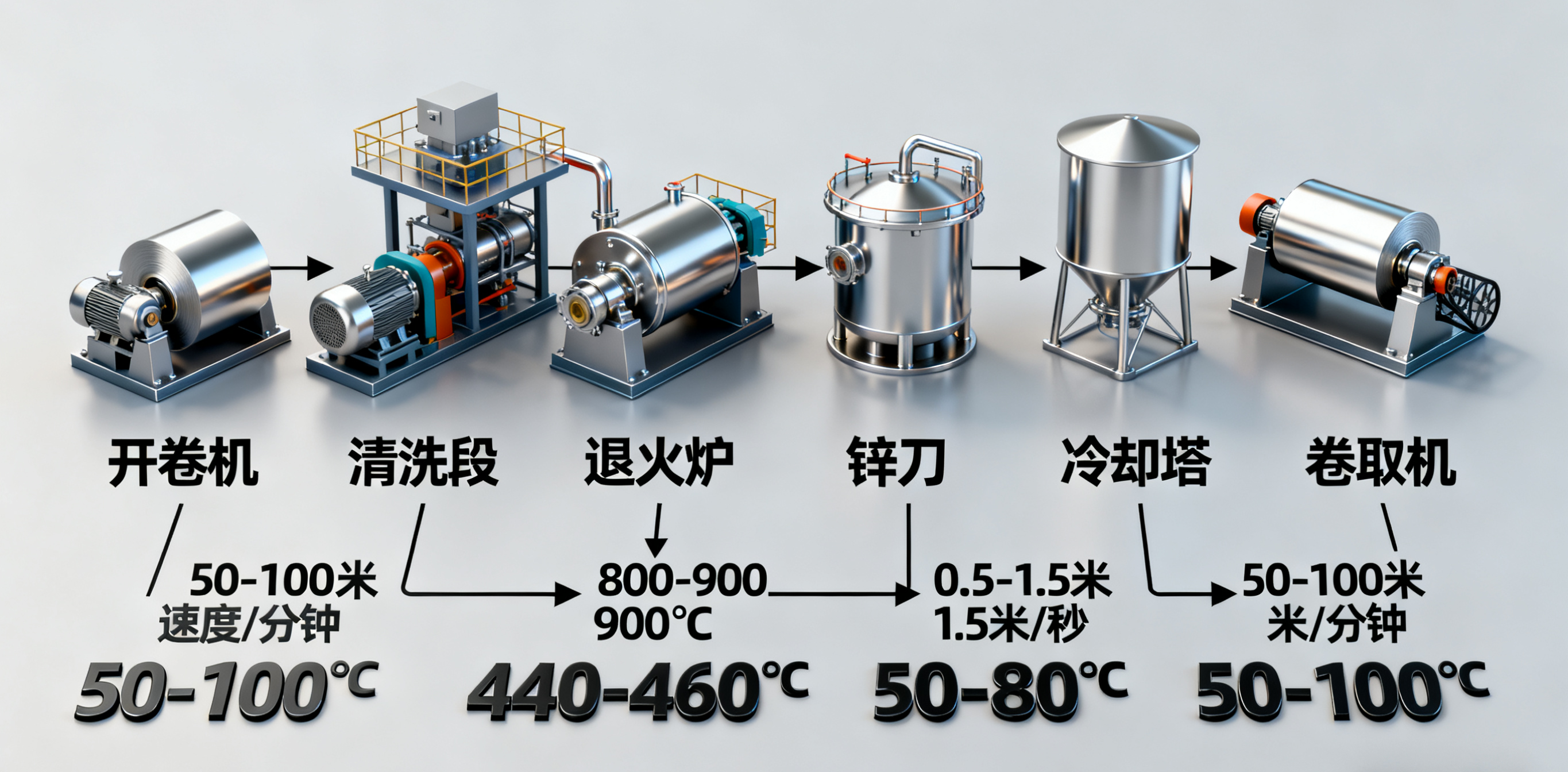
The production of ZAM sheets employs a continuous hot-dip coating process. The core flow is similar to traditional galvanized sheets but has specific requirements regarding alloy bath ratio, temperature control, and post-treatment. The specific process is as follows:
- Raw Material Preparation
Cold-rolled or hot-rolled steel sheets are selected as the base material, with a thickness range of 0.2-6.0mm and a width of 800-1800mm. The base material must meet strict surface quality requirements—free of scale, oil, scratches, etc.—as defects would affect coating adhesion.
- Degreasing and Cleaning
The base material is fed into a cleaning line where multiple processes (alkaline degreasing, hot water rinsing, electrolytic cleaning) remove oil, dust, and other impurities. The surface of the base material must remain clean and dry after cleaning to avoid residual contaminants affecting coating quality. Recommended image:实景 photo of a degreasing and cleaning production line.
- Annealing
After cleaning, the base material enters a continuous annealing furnace. Under a protective atmosphere of nitrogen and hydrogen, it is heated to 700-800°C and held at that temperature for a certain period. The purpose of annealing is to eliminate rolling stress in the base material, improve its microstructure, and simultaneously form an active pure iron layer on the surface, creating conditions for the subsequent metallurgical bonding between the coating and the base material.
- Hot-Dip Coating
After annealing, the base material is rapidly immersed into a zinc-aluminum-magnesium alloy bath. The bath temperature is strictly controlled at 460-480°C (10-20°C higher than traditional galvanizing bath temperatures). The base material is immersed for 3-5 seconds to ensure the coating uniformly covers the surface. The content of zinc, aluminum, magnesium, and other elements in the bath must be monitored in real-time, and consumed alloy elements are replenished via an automatic feeding system to maintain stable composition.
- Coating Thickness Control
After being drawn from the alloy bath, the base material passes through an air knife system (high-pressure nitrogen nozzles) to control coating thickness. The pressure, distance, and angle of the air knife can be precisely adjusted to achieve accurate control of coating thickness within the range of 30-200g/m² (double-sided). For products with higher requirements, electromagnetic induction can also be used to assist in thickness control. Recommended image:实景 photo of the air knife control section of a hot-dip coating production line.
- Cooling and Solidification
The sheet after air knife control enters a cooling unit for rapid cooling. A staged cooling method (water cooling + air cooling) is adopted, with the cooling rate controlled at 10-20°C/s. This ensures the coating solidifies rapidly, forming a uniform and dense microstructure, and prevents defects like cracks or peeling in the coating.
- Post-Treatment
After cooling, the sheet requires post-treatment to further enhance corrosion resistance and surface quality:
- Passivation: Using chromate or chromate-free (eco-friendly) passivation to form a passivation film on the coating surface, enhancing corrosion resistance.
- Oiling: Spraying rust-preventative oil to prevent rusting during storage and transportation (oil-free products can be chosen based on customer needs).
- Anti-fingerprint Treatment: Applying an anti-fingerprint coating to the surface to enhance wear resistance and aesthetics, catering to the needs of industries like appliances.
- Finishing and Shearing
After post-treatment, the sheet undergoes leveling, edge trimming, and surface inspection. It is then cut into sheets or coils according to customer orders, followed by packaging, labeling, and warehousing.
Typical Application Scenarios
Leveraging its comprehensive performance advantages, the application fields of ZAM sheets are continuously expanding, making it the preferred material in several industries.
- Construction Field
The construction industry is the largest application area for ZAM sheets, accounting for approx. 40%. It is mainly used for:
- Roofing and Wall Systems: Roofing tiles and wall color panels for factories, warehouses, and stadiums, especially suitable for buildings in coastal areas and high-humidity regions (e.g., projects in Hainan, Guangdong, Fujian provinces).
- Building Studs and Brackets: Ceiling studs, partition wall studs, and photovoltaic bracket bases, replacing traditional galvanized studs to enhance service life.
- Doors, Windows, and Curtain Walls: High-end window/door frames and curtain wall studs, combining corrosion resistance with decoration.
- Municipal Facilities: Street light poles, traffic sign poles, guardrails, trash cans, etc., requiring no frequent maintenance during outdoor use.
Recommended image:实景 photo of a ZAM sheet roofing project, photo of building stud installation site.
- Appliance Industry
The appliance industry has high requirements for material corrosion resistance, processability, and aesthetics. ZAM sheets are mainly used for:
- White Goods: Side/back panels for refrigerators, inner drums for washing machines, outer shells for air conditioners, inner tanks for water heaters.
- Brown Goods: Back panels for TVs, speaker housings.
- Small Appliances: Outer shells for microwaves, inner tanks for ovens, outer shells for water dispensers.
For example, after a well-known appliance brand used ZAM sheets for refrigerator side panels, the corrosion failure rate in humid environments dropped from the original 3% to 0.5%, while the processing pass rate increased by 5%. Recommended image: Finished photo of ZAM sheets for appliance housings, photo of the stamping process.
- Transportation Field
The transportation field has strict requirements for material corrosion resistance, strength, and lightweighting. Applications for ZAM sheets include:
- Automotive: Chassis components (e.g., cross members, longitudinal members), door inner panels, trunk floor panels, exhaust pipe brackets. It is especially suitable for new energy vehicles to reduce corrosion risks in battery compartments.
- Containers and Logistics Equipment: Floor/side panels for containers, logistics turnover boxes, enhancing service life during ocean and long-distance transportation.
- Rail Transit: Interior panels for subway cars, guardrails for high-speed rail platforms, supports for light rail.
Recommended image: ZAM sheets for automotive chassis components, photo of container sheets being loaded.
- New Energy Field
The rapid development of the new energy industry has provided vast application space for ZAM sheets, mainly used for:
- Photovoltaic (PV): PV brackets, component frames, inverter housings, suitable for outdoor PV power stations (especially in harsh environments like coastal areas and deserts).
- Energy Storage: Outer shells for energy storage cabinets, trays for storage batteries, enhancing the outdoor weather resistance of energy storage equipment.
- Wind Power: Accessories for wind turbine towers, outer shells for nacelles.
For example, after a large PV power station adopted ZAM sheet PV brackets, the designed service life of the brackets was extended from 20 years to 30 years, and运维 costs were reduced by 40%. Recommended image:实景 photo of PV bracket installation, finished photo of energy storage cabinet shells.
- Other Fields
In addition to the above industries, ZAM sheets are also widely used in:
- Agricultural Machinery: Outer shells for tractors, support frames for farm equipment, adapting to humid and dusty field environments.
- Chemical Equipment: Support brackets for chemical pipelines, outer shells for storage tanks (non-direct contact with corrosive media).
- Furniture Industry: Metal furniture frames, outdoor leisure furniture, combining corrosion resistance with aesthetics.
Industry Standards and Quality Control
- Main Industry Standards
Currently, industry standards for ZAM sheets are gradually improving. Major domestic and international standards include:
- International Standard: ISO 16156 (Hot-dip zinc-aluminum-magnesium alloy coated steel sheet)
- European Standard: EN 10346 (Continuously hot-dip coated steel sheet)
- Japanese Standard: JIS G 3321 (Hot-dip zinc-aluminum-magnesium alloy coated steel sheet and strip)
- Chinese Standard: GB/T 34222 (Hot-dip zinc-aluminum-magnesium alloy coated steel sheet and strip)
These standards clearly define indicators such as coating composition, coating thickness, corrosion resistance, adhesion, and processability. For example, GB/T 34222 requires that after adhesion testing (bending test), the coating must show no peeling or flaking; the salt spray test life must be no less than 5000 hours (coating thickness ≥60g/m²).
- Key Quality Control Indicators
Manufacturers ensure product quality through the following indicators:
- Coating Composition: Using spectrometers to monitor bath composition in real-time, with deviations controlled within ±0.1%.
- Coating Thickness: Detected using X-ray thickness gauges, with single-point thickness deviation ≤±5%.
- Corrosion Resistance: Sampling and conducting salt spray tests for each batch to ensure standards are met.
- Adhesion: Tested via bending tests and cross-cut tests, with adhesion等级 ≥1.
- Surface Quality: Inspected via visual checks and surface roughness meters, ensuring no obvious scratches, pitting, or color differences.
Recommended image:实景 photo of coating thickness inspection, scene of a salt spray test laboratory.
Market Development Trends
- Rapid Market Growth
In recent years, the global ZAM sheet market has shown a high-growth trend. In 2023, the global market size reached 8.5 billion USD, a 62% increase compared to 2020; the Chinese market size was 5.27 billion USD, accounting for 62% of the global market, making it the world's largest producer and consumer. It is estimated that from 2024 to 2028, the global market will continue to grow at an annual compound growth rate of 9.2%, reaching 13.2 billion USD by 2028.
- Technology Upgrade Directions
- Development of High-Magnesium Alloys: Increasing the magnesium content in the coating (Mg≥3%) to further enhance corrosion resistance, meeting the needs of marine engineering and extreme corrosive environments.
- Ultra-Thin Coating Technology: Reducing coating thickness (e.g., below 30g/m²) while ensuring anti-corrosion performance, thereby lowering production costs.
- Development of Functional Coatings: Developing composite coatings with antibacterial, wear-resistant, and self-cleaning functions to expand application scenarios.
- Eco-Friendly Production Processes: Promoting chromate-free passivation and water-saving cleaning processes to reduce environmental impact.
- Application Field Expansion
In the future, the application of ZAM sheets will extend to more high-end fields, such as:
- Marine Engineering: Guardrails for offshore platforms, support brackets for submarine pipelines.
- Aerospace: Auxiliary structures for aircraft components.
- Electronic Equipment: Outer shells for high-end electronic devices, server chassis.
- Industry Competition Landscape
Currently, the major global players in the ZAM sheet market include Baowu, HBIS, Angang, POSCO, and JFE. Chinese enterprises,凭借 cost advantages and production scale, dominate the mid-to-low-end markets. Korean and Japanese enterprises hold technological advantages in the high-end product sector. As Chinese enterprises increase R&D investment, their competitiveness in the high-end product market will gradually improve.
Conclusion
As a new type of alloy-coated steel sheet, ZAM is gradually changing the application landscape of traditional metal materials with its superior corrosion resistance, self-healing capability, processability, and cost-effectiveness. With continuous technological upgrades and the continuous expansion of application fields, ZAM sheets will occupy a more important position in the future materials market, providing reliable material support for the high-quality development of various industries. Whether it is long-term anti-corrosion in construction projects, quality enhancement in appliance products, or outdoor durability assurance for new energy equipment, ZAM sheets will become the preferred material, demonstrating broad development prospects.